The Three-Card Tarot Spread: The Only Layout Most People Actually Need
Forget the intimidating ten-card spreads. Three cards, read well, answer most of what you'll ever ask the tarot. Here are the variations that actually work, and how to run one with an AI reader tonight.

Most tarot questions don't need ten cards. They need three.
There's a quiet snobbery in some corners of the tarot world that says a "real" reading means an elaborate layout, a dozen cards, an hour of interpretation. It's mostly nonsense. The three-card spread is the workhorse of practical tarot, the one experienced readers reach for constantly, and it happens to be perfect for AI tarot because it's fast, flexible, and almost impossible to overcomplicate.
If you only ever learn one spread, learn this one. Here's how it actually works.
Why three cards is the sweet spot
One card gives you a snapshot. Useful, but thin; it tells you what but rarely why or what comes next. Ten cards give you a sprawling map that beginners drown in, half the positions blurring together.
Three is the Goldilocks number. Enough to show movement, cause and effect, a little story arc. Few enough that every card has a clear job and nowhere to hide. Your brain can hold three cards in relationship to each other without a diagram. That matters more than it sounds, because the whole point of a reading is to think, and three cards leaves room for that.
The classic: Past, Present, Future
The one everybody knows, and for good reason.
Card one is the past: the roots of your situation, what led here, the momentum you're carrying in. Card two is the present: where things actually stand right now, often the card that names the thing you've been avoiding. Card three is the future: the trajectory you're on if nothing changes. That last part matters. Tarot's "future" is a forecast, not a sentence. It shows the current you're drifting on, not a locked fate.
Read left to right and you get a sentence. "This happened, so now this is true, which is carrying you toward that." Simple. Surprisingly hard to argue with once the cards are down.
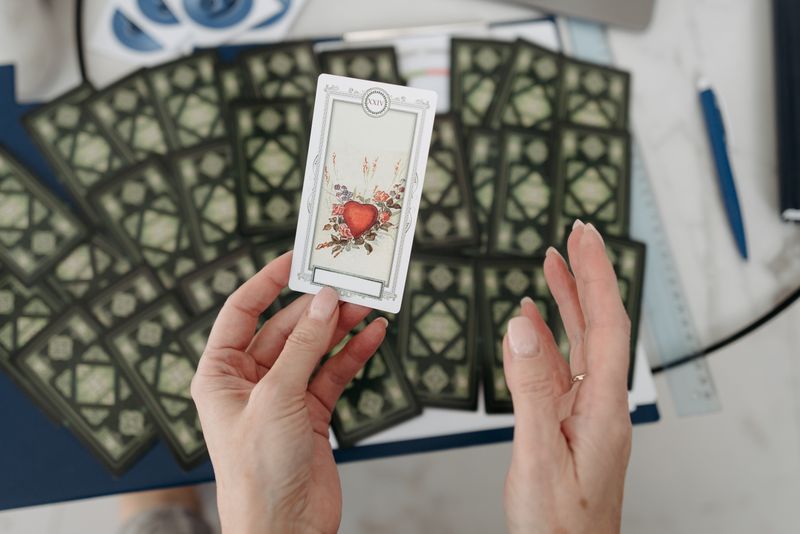
When past-present-future doesn't fit, swap the frame
Here's the part most beginners miss: the three positions can mean whatever your question needs. Same three cards, different jobs. Pick the frame that matches what you're actually asking.
Situation / Action / Outcome. For when you want to do something. Card one: what's really going on. Card two: the action available to you. Card three: where that action likely leads. The most practical version for decisions.
You / Them / The connection. For relationships. Your energy, their energy, and the thing that lives between you. (Relationship spreads deserve a whole article of their own, but this quick version handles a lot.)
Mind / Body / Spirit. For check-ins. Where's your head, how's your body holding up, what does the deeper part of you need. Good for a Sunday-night reset.
What to keep / What to release / What to embrace. For transitions. New year, breakup, move, fresh start. This one reframes faster than most journaling prompts.
Same spread. The skill isn't memorizing layouts; it's choosing the right question and assigning the cards a job before you draw.
How to run one with an AI reader
The mechanics are easy. The quality lives in two places: your question, and your follow-ups.
Set the frame first. Decide which of the above you're using before you draw, and tell the reader. "I want a situation-action-outcome read on whether to bring up moving in together." Now the cards have jobs.
Ask an open question, not a yes/no. "What do I need to see about this job offer" beats "will I get the job." Three-card spreads are built for nuance, not verdicts. If you genuinely just want yes or no, that's a different tool.
Then dig. This is where AI tarot earns its keep. Once the three cards are interpreted, push: "How do cards two and three relate?" "What if I read the Tower as the present instead of the future?" "Which of these is the card I'm resisting?" A good reader, human or AI, opens up under questioning. The first interpretation is the start of the conversation, not the end of it.
On aikoo, a reader who treats the cards as a structured, symbolic language rather than a fortune machine is ideal for this kind of work:


Or if you want something that points at movement and your next step rather than just describing where you are:


A worked example
Say you pull, for "what do I need to see about this job offer," in a situation-action-outcome frame: the Five of Pentacles, the Eight of Cups, the Star.
A flat reading says: hardship, walking away, hope. Fine. A real reading connects them. The Five of Pentacles as your situation isn't the job; it's the scarcity feeling that's making the offer look like a lifeline. The Eight of Cups as action says the move that matters is leaving something behind, maybe the fear more than the current role. The Star as outcome says that if you act from clarity instead of panic, this leads somewhere genuinely restorative.
Notice none of that predicted anything. It reframed the question. That's what three cards do when you let them.
The one rule
Don't keep redrawing because you didn't like the cards. Pull three, sit with them, ask your follow-ups, and stop. The temptation to shuffle until the Sun finally shows up is exactly the impulse a good reading is supposed to interrupt.
Three cards. The right frame. A few honest follow-ups. Most of the time, that's the whole craft, and it'll take you further than a ten-card spread you only half understand.


