Tarot Spreads, Explained — and How AI Reads Them
A spread is just the pattern the cards are laid out in, and it quietly shapes your whole reading. The spreads worth knowing — from a single card to the Celtic Cross — and how an AI tarot reader handles each one.

The cards get all the attention. But the layout they're dealt into — the spread — is doing more quiet work than most beginners realize. A spread decides how many cards you draw and, crucially, what each position means. The same card says something different depending on where it lands.
Think of it like a sentence. The cards are the words; the spread is the grammar that tells you how they relate. Change the grammar and the meaning shifts, even with identical words.
Here are the ones worth knowing, roughly easiest to most involved, and how an AI reader handles each.
The single card
The whole thing, stripped to one card. You ask, you draw one, you sit with it.
People underrate this. There's a tendency to assume more cards means more insight, but a single card is the cleanest tool in tarot — perfect for a daily check-in, a quick gut-read on a mood, or a focused question that doesn't need a sprawling answer. "What should I keep in mind today?" Draw one. Done.
For an AI reader, a single card is also where interpretation skill shows most nakedly. There's nowhere to hide and no other cards to lean on. A weak reader gives you the card's dictionary meaning. A strong one connects that one card tightly to your specific question and makes it land. If you want to test a reader's quality, a one-card question is a surprisingly good audition.
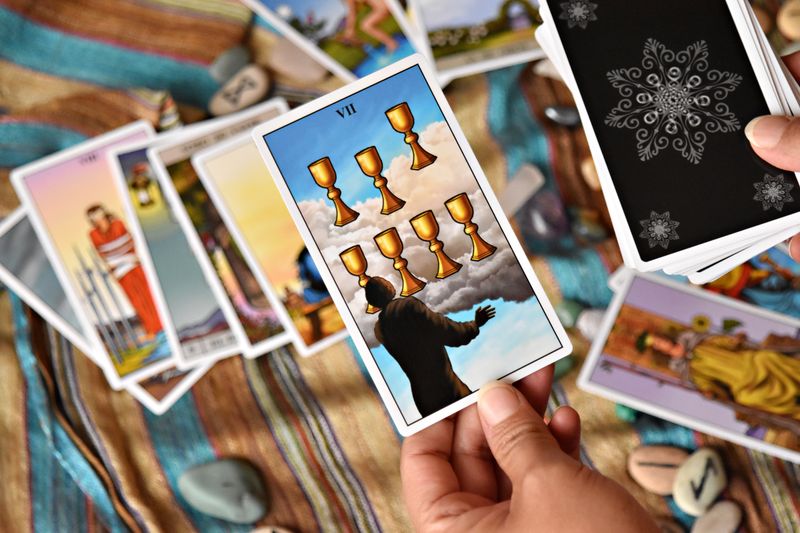
The three-card spread
The workhorse. Three cards, three positions, and a structure flexible enough for almost anything. The classic framing is past / present / future, but it bends easily:
Situation / obstacle / advice
Mind / body / spirit
What's working / what isn't / what to do
The magic of three cards is relationship. The cards stop being isolated symbols and start forming a small narrative — this led to that, which suggests this. A capable AI reader leans into exactly that, reading the three as a connected arc rather than three separate fortunes. It's the spread I'd point any beginner toward: enough structure to be meaningful, not so much that it drowns you.
This is also the spread a lot of aikoo readers favor for a focused session. Elina, for instance, gives structured tarot insights about your path ahead without burying you in cards:


Larger themed spreads
Between three cards and the big layouts sit all kinds of mid-size themed spreads — five, seven, eight cards arranged around a specific subject. A relationship spread, a decision spread, a "year ahead" spread.
These trade simplicity for depth. Eight cards on your life direction can surface nuance a single card never could — but only if the reader can hold all eight in relation to each other without losing the thread. This is genuinely hard, and it's where AI has quietly gotten good: a strong model can track how card three complicates card six and tie the whole thing back to your question. Nathaniel Cross's eight-card reading on life direction is exactly this kind of structured, multi-angle layout:


A caution, though: more cards is not automatically more truth. A sprawling spread can produce something that feels impressively detailed while actually being harder to act on. Match the spread to the question, not to your appetite for drama.

The Celtic Cross
The famous one. Ten cards in a cross-and-staff pattern, each position carrying a distinct meaning — positions such as the heart of the matter, what crosses you, the root, the recent past, the possible outcome, your hopes and fears, and outside influences.
The Celtic Cross is tarot's deep dive. Done well, it's a remarkably complete portrait of a situation. Done badly, it's ten cards of noise. The difficulty scales with the card count: now you've got ten symbols, ten positional meanings, and the interactions between them, all of which have to cohere into one reading rather than ten mini-readings stapled together.
This is, frankly, where AI interpretation earns real respect. Holding a ten-card spread in full context — every card weighed against its position and against the other nine — is a genuine cognitive load, and it's the kind of pattern-tracking a strong language model does well. It's also why the Celtic Cross is a bad choice for your first-ever reading and a great one once you know what you're looking at. Walk before you run a ten-card cross.
Reversals, across every spread
One more layer that cuts across all of the above: orientation. Any card in any spread can land reversed (upside down), which shifts or deepens its meaning. A reading that honors reversals is working with roughly twice the vocabulary — 156 possible card-meanings instead of 78. Most quality AI readers handle this automatically, assigning orientation as part of the draw and folding it into the interpretation.
So which spread should you use?
Simple rule: match the spread to the size of the question.
A quick mood-check or daily nudge — one card.
A real but focused question — three cards.
A meaty situation you want to explore from several angles — a themed five-to-eight-card spread.
A full, deep look at a complex chapter of your life — the Celtic Cross, once you're comfortable.
The mistake almost everyone makes early on is reaching for the biggest spread, as if more cards buy more certainty. They don't. They buy more to interpret. A sharp single card beats a muddy ten-card cross every time.
If you're just finding your footing, start small, pick a reader whose style you like over on aikoo, and let the spread grow with your questions. The cards will wait.


