Reversed Cards in AI Tarot: What an Upside-Down Card Really Means
A card lands upside down and your stomach drops. Don't panic. Reversed cards aren't bad omens, they're nuance. Here's how to read reversals, and how AI tarot handles them.

A card turns up upside down and something in you flinches. Reversed. That can't be good, right?
Take a breath. Reversed cards are probably the most misunderstood part of tarot, blamed for a lot of needless dread. An upside-down card is not a curse, a bad omen, or the universe slamming a door. It's a modifier, not a verdict. Learning to read reversals is what takes a reading from black-and-white into something with actual depth.
This trips up beginners constantly, and AI tarot adds its own wrinkle, so let's clear it up.
What a reversal actually is
Mechanically, it's simple: a reversed card is one that comes out upside down from the reader's point of view, so its image is inverted. In a physical deck this happens through shuffling. The card's core meaning doesn't vanish; it picks up a twist.
The mistake is thinking "reversed" means "the opposite" or "the bad version." Sometimes it leans that way, but more often it's subtler. There are a few schools of thought, and they're worth knowing, because a good reader (and a good AI) will usually be working from one of them.
The main ways to read a reversal
Blocked or internalized energy. The most common reading. The card's energy is present but turned inward, stuck, or not fully expressed. Upright Strength is confident courage; reversed, it might be that same strength turned inward as self-doubt, or courage you have but aren't using.
The lower, or shadow, expression. The card's more difficult face. The Ten of Cups upright is domestic bliss; reversed, it can point to the gap between the picture-perfect ideal and a messier reality.
Delay or resistance. The card's energy is coming, but slowed, met with friction, or not yet ripe. Less "no," more "not yet" or "not without effort."
Reduced intensity. Simply a softer dose of the upright meaning. A reversed card can just turn the volume down.
Notice that none of these is "doom." Even reversed, the Tower or the Three of Swords is usually pointing at something workable: an energy turned inward, a process delayed, a lesson half-learned. Reversals add texture. They rarely add catastrophe.
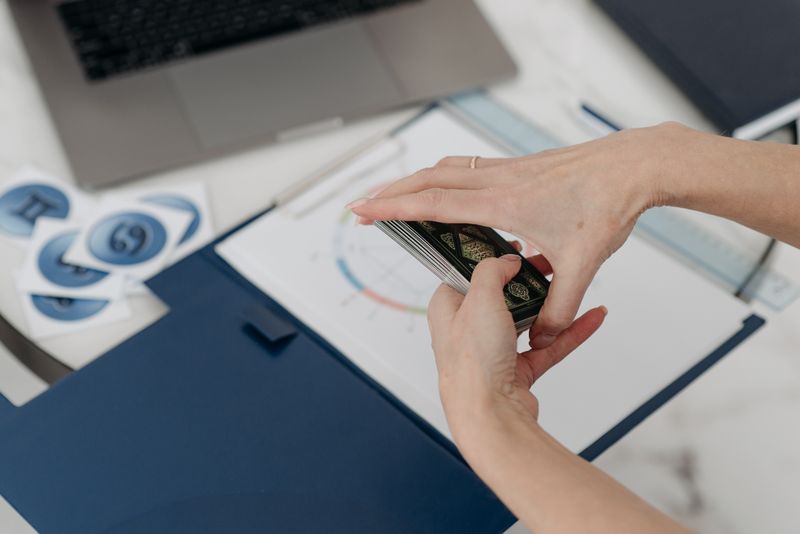
The AI tarot wrinkle
Here's where AI readings differ from a physical deck, and it's worth understanding.
A physical card flips because of how it was shuffled, a genuinely random orientation. An AI doesn't shuffle a real deck. Whether reversals appear at all depends on how the reader is built. Some include them, assigning each card an orientation. Some skip them entirely and read everything upright, leaning on card combinations for nuance instead. Neither is wrong; they're just different styles.
In practice, you can just ask. "Do you use reversals?" is a completely fair question to put to an AI tarot reader, and a good one will tell you. You can also steer it. "Please include reversals in this reading" or "read everything upright, I find reversals confusing" are both legitimate requests. The orientation is a setting, not a sacred law, and a reader worth its salt will explain how it's handling them rather than hand-wave.
If a reading throws a reversed card at you, the move is the same as with any card: ask why. "Why might this be reversed here?" "Is this blocked energy, or just a softer version?" The answer is where the actual insight lives.
Should beginners bother with reversals?
Honest answer: not at first, if you don't want to.
Plenty of professional readers work entirely upright and still get rich, accurate readings by leaning on context and how the cards interact. Doubling your deck's meanings from 78 to 156 right out of the gate is a fast way to overwhelm yourself. There's no shame in reading all-upright while you build fluency, then adding reversals once the upright meanings feel like second nature.
With an AI reader this is even easier, since you can simply set the preference and change your mind later. Start where you're comfortable.
Reframing the flinch
The reason reversed cards feel ominous is mostly cultural. Upside down reads as "wrong" before we've even thought about it. But tarot was never a tidy split between good cards and bad cards, and reversals are the clearest proof. They're the deck's way of saying it's more complicated than that, which, when you think about it, is true of almost everything worth asking about.
If you want the cards read straight, with the reversals and the hard angles left in rather than smoothed over, aikoo has readers built for exactly that. One offers unfiltered, grounded insight without the emotional padding:


And if you want that honesty delivered with more warmth, there's a reader who'll face the difficult cards alongside you, gently:


So the next time a card lands upside down, don't brace for bad news. Lean in and ask what shade of the story it's adding. That curiosity, rather than the dread, is the whole point of reading reversed at all.


