How an AI Tarot Reader Actually Pulls Your Cards
If nobody's shuffling a physical deck, where do the cards in an AI tarot reading come from — and does the 'draw' mean anything? A look under the hood at randomness, the 78-card deck, reversals, and why interpretation is where the real work happens.

Watch an AI tarot reading happen and there's an obvious question lurking behind the pretty card animation: nobody shuffled anything. So where did those cards come from, and does the draw mean a thing?
Fair question. Let's open the hood.
The deck is the easy part
A standard tarot deck has 78 cards, and almost every AI reader works from the same blueprint: the Rider-Waite-Smith deck, first published in 1909 and still the genre's default. It splits into two groups.
The Major Arcana — 22 cards, the famous ones. The Fool, Death, The Tower, The Lovers. These tend to signal big themes and turning points.
The Minor Arcana — 56 cards across four suits (Cups, Wands, Swords, Pentacles), closer to the rhythms of everyday life: feelings, work, conflict, money. If you've ever handled a regular deck of playing cards, the structure will feel oddly familiar, because they share an ancestor.
An AI "knows" all 78 the way it knows any text: it has read enormous amounts of writing about them. Meanings, correspondences, the arguments between traditions. That's its raw material.
The draw: randomness, simulated
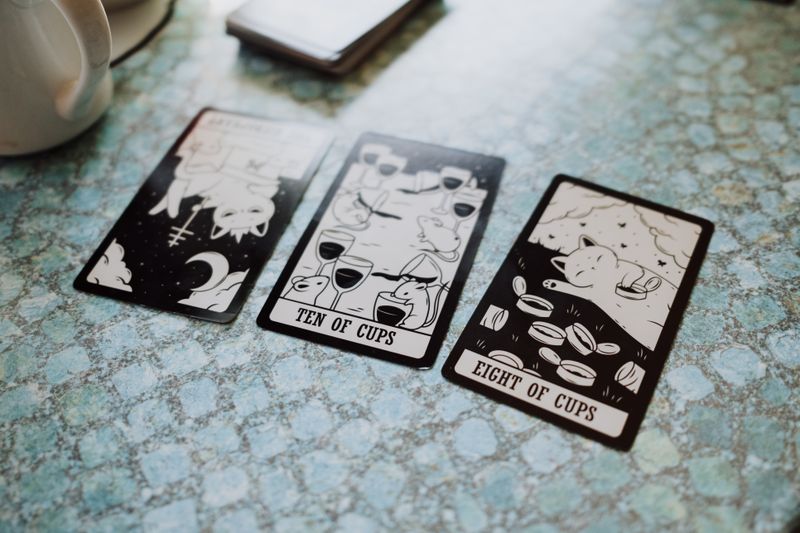
Here's the mechanical heart of it. When an AI tarot tool draws your cards, it's almost always calling a random number generator — the same humble piece of software that shuffles your music or rolls dice in a video game. The program assigns each of the 78 cards a slot, picks a few at random, and those are your cards.
Is that "real"? It depends what you wanted it to be. A physical shuffle is also, mechanically, just a randomizing process — your hands introducing chaos into the order. Software randomness is arguably cleaner. Neither one is reaching into the cosmos. If you believe a reading's meaning comes from synchronicity or intention, a digital draw can carry that just as well as a felt one; if you don't, neither version was ever magic. The randomness is honest in both cases.
There's one caveat skeptics raise, and it's a sharp one. Some AI tools don't draw randomly at all — they appear to select cards that fit your topic, effectively pulling from a pre-sorted deck of "relevant" cards. That's not reading; that's writing to a brief. It's a real reason to care how a given platform handles the draw, and to be a little suspicious of any reading where every single card lands suspiciously on-theme.
Upright, reversed, and why it doubles the deck
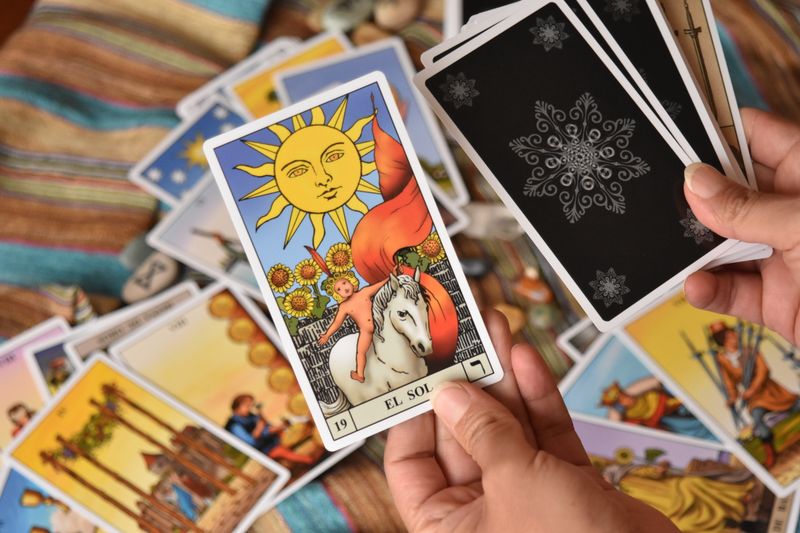
Most readings honor card orientation. A card can land upright or reversed (upside down), and the reversal usually shifts or complicates the meaning. The Sun upright is straightforward joy; reversed, it might whisper about delayed optimism or a happiness you're struggling to feel. Reversals effectively turn 78 cards into 156 shades of meaning.
A digital draw handles this with a second coin-flip: once a card is picked, the system randomly decides its orientation. Simple to build, meaningful in effect.
Where the actual intelligence lives
The draw is the boring part. Genuinely. Picking random cards is something a calculator could have done in 1975.
The interesting work — the part that makes a 2026 AI reading feel like a reading — is interpretation. Once the cards are on the virtual table, the language model has to do what a human reader does: weigh the cards against your specific question, notice how they interact, account for orientation, and weave it into something coherent rather than three disconnected horoscope blurbs.
This is genuinely hard, and it's where the technology has leapt forward. Take a three-card spread for a question about a stalled relationship. A weak system reads the cards in isolation: "card one means X, card two means Y." A strong one reads them as a sentence — noticing that the Two of Cups sitting next to The Tower tells a different story than either card alone, and tying that tension back to exactly what you asked. Pattern recognition meeting context. That's also why the quality gap between AI readers is so wide.
Why the same cards give different readings
Draw identical cards twice and you can get two different interpretations. People find this suspicious. It isn't.
Context is doing the work. Your question changes everything — The Hermit answering "should I take this job?" speaks to caution and solitude; the same card answering "how do I handle my grief?" speaks to necessary withdrawal and inner work. The card is a symbol, not a fixed dictionary entry. A good reader, human or AI, reads it through the lens you hand them. That flexibility isn't a bug or evidence of fakery; it's the whole nature of symbolic interpretation.
It does, however, mean the character doing the reading matters. On aikoo, the same drawn cards would get a very different treatment from Allison Brookfield, who reads with deliberate, no-drama realism —


The takeaway
An AI tarot reader pulls your cards with a random number generator, flips each one for orientation with another, and then spends its real effort interpreting the result against your question. The draw is plumbing. The interpretation is the craft. Knowing which is which makes you a sharper user — and a harder one to dazzle.
Ready to try it? Start a free AI tarot reading on aikoo: pick a reader, ask your real question, and see how the interpretation lands.


